What you can do with it
It is not a report. Every chapter ends in something to go and do, and two of them you can do before the end of today.
Find out whether engines name you at all
Chapter 9 is a 60-minute self-audit: the questions to ask, how to ask them so the answer is not personalised, and how to score what comes back. Most teams have never once read what an engine says about their category. You can do it tonight, without buying anything.
Diagnose which problem you actually have
Being absent from a model's weights and being present but never recommended look identical in every dashboard, and they need opposite fixes. Chapter 3 is a ladder that tells the two apart before you spend a quarter on the wrong one.
Hand it to Claude or ChatGPT and make it do the work
The PDF is text, not scanned images, so a model reads all of it. Drop it in and ask it to apply chapter 8 to your own site, or to rewrite your category page against the writing rules in chapter 6. That is the fastest route from reading to shipping, and it is what we would do.
Run the 30-day plan, or hand it to whoever does
Chapter 8 is four weeks, one job per week, starting with measurement so the rest is checkable. It is written to be delegated: the deck version is the same plan sized for the meeting where it gets approved.
It is the same playbook we run on clients
Written down after the fact, not before it. Both of these are checkable, and the second one includes the part that did not hold.
Velar — Bitcoin perpetual futures, settled through Stacks
Ask ChatGPT, Claude, Grok or Google AI Overviews today who built the world’s first bitcoin perp DEX. All four answer Velar.
What we did. The category had no written definition anywhere, so nobody was cited for it. Kunzum wrote one — world’s first bitcoin perpdex — and placed it where retrieval reads rather than where posts get shared.
How to check it. Complete transcripts, collected 9 September 2026 through the DataForSEO APIs and re-runnable against the same prompt, are on the Velar case study.
For context on the company rather than the work: Velar raised $3.5M in seed funding, reported by CoinDesk on 1 February 2024, and its PerpDex went live on Stacks. Kunzum’s part was the category positioning, not the raise.
Panther Protocol — Privacy infrastructure — zero-knowledge proofs, MPC, rollups
Four years on, that corpus still holds Google’s top ten on seven of the twelve target queries we sampled, and organic first place on ring signatures vs zksnarks.
What we did. Twenty-two Academy articles, published June 2022 to April 2023, each one written as the definition or the comparison nobody had bothered to write down properly.
How to check it. Sampled 18 September 2026, United States, top 20 organic. Being straight about the other five: they no longer rank in the top 20 at all. The head terms — MEV, account abstraction — went to a16z, ethereum.org and Chainlink. The ones that held are the definitional and comparison queries, which is the part of the method this playbook is about.
Get the playbook
One email address. The book comes back as a PDF and the deck comes with it.
What is inside
Ten chapters. If you have ten minutes, chapter one and the plan in chapter eight are the ones that matter.
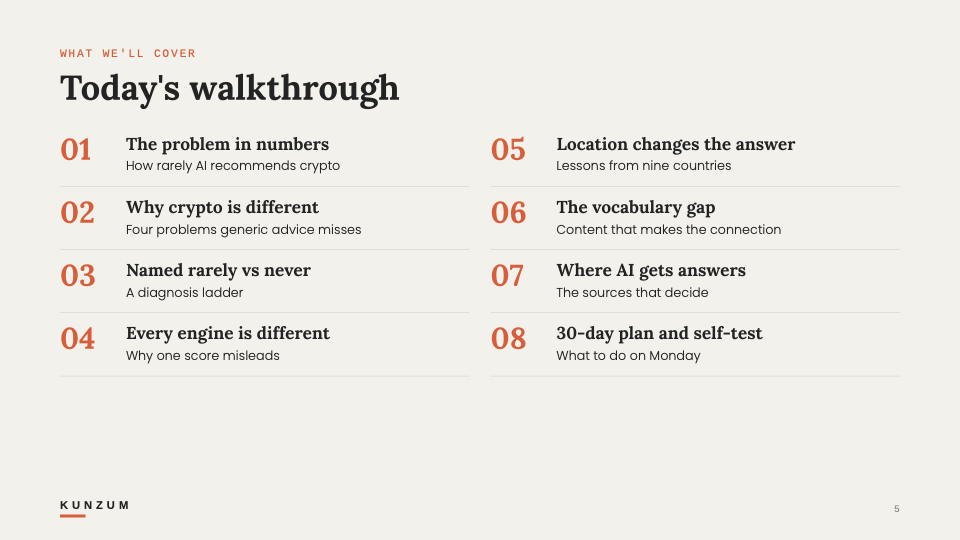
- The problem in numbersHow rarely AI recommends crypto, and why that matters.
- Why crypto needs its own playbookFour problems generic AEO advice does not cover.
- Named rarely vs named neverA diagnosis ladder with a different fix for each rung.
- Every engine is differentWhy one AI visibility score hides the real problem.
- Location changes the answerWhat nine countries taught us.
- Closing the vocabulary gapWriting for people who do not know your category exists.
- Where AI gets its crypto answersThe sources that decide who gets named.
- The 30-day action planA week-by-week plan you can start on Monday.
- Test your own brand in 60 minutesA do-it-yourself version of the audit.
- Methodology and limitsHow the data was collected, and what it cannot tell you.
Read the slides right here
The same argument as a 33-slide deck, for presenting internally or sending to somebody who will not open a 14-page PDF. No form for this one.
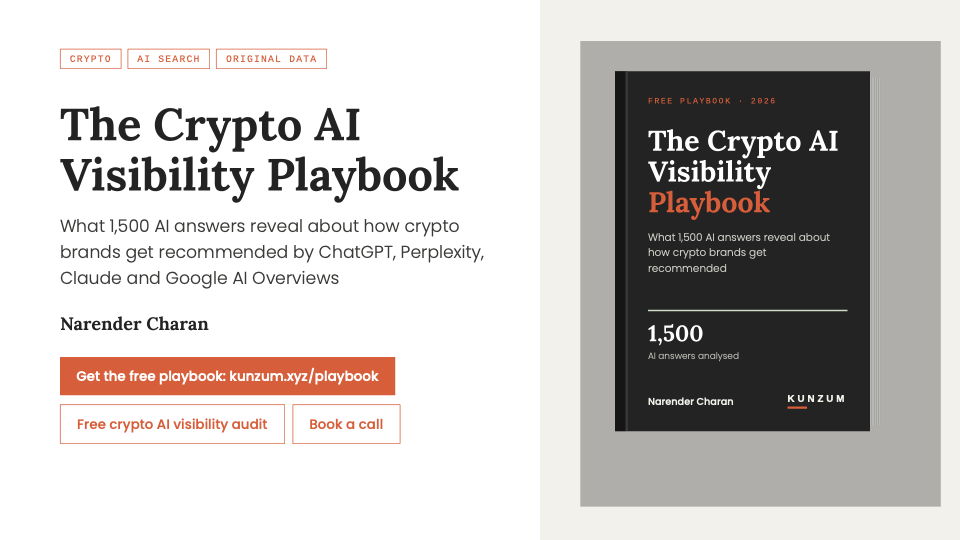
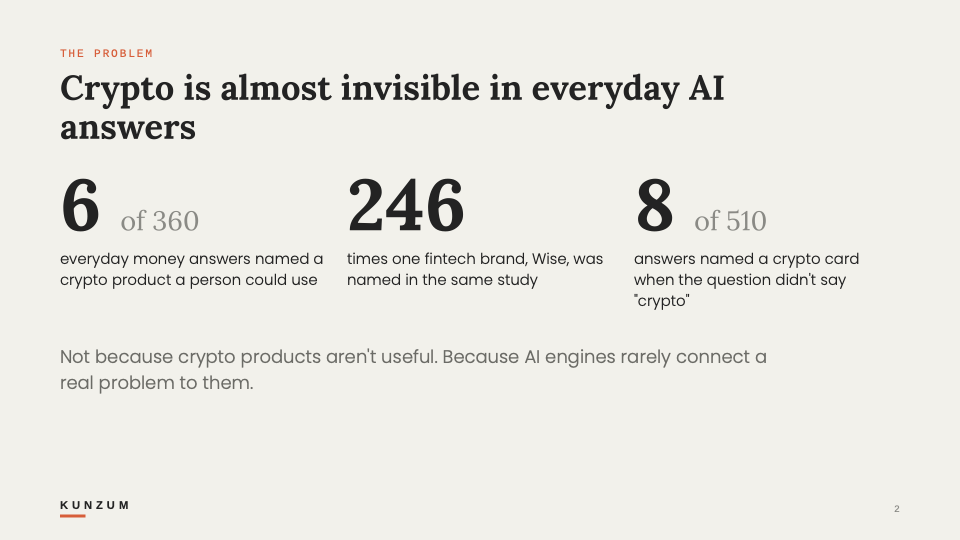
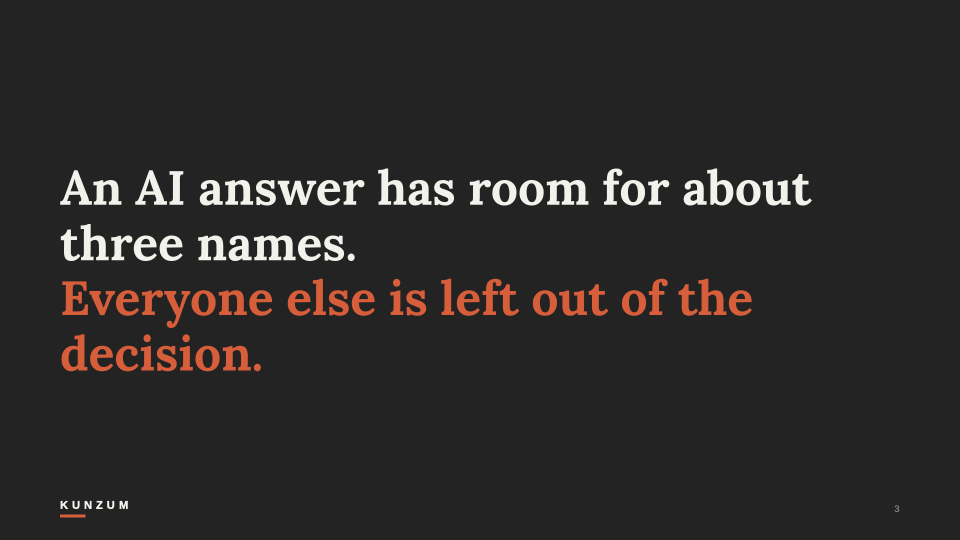
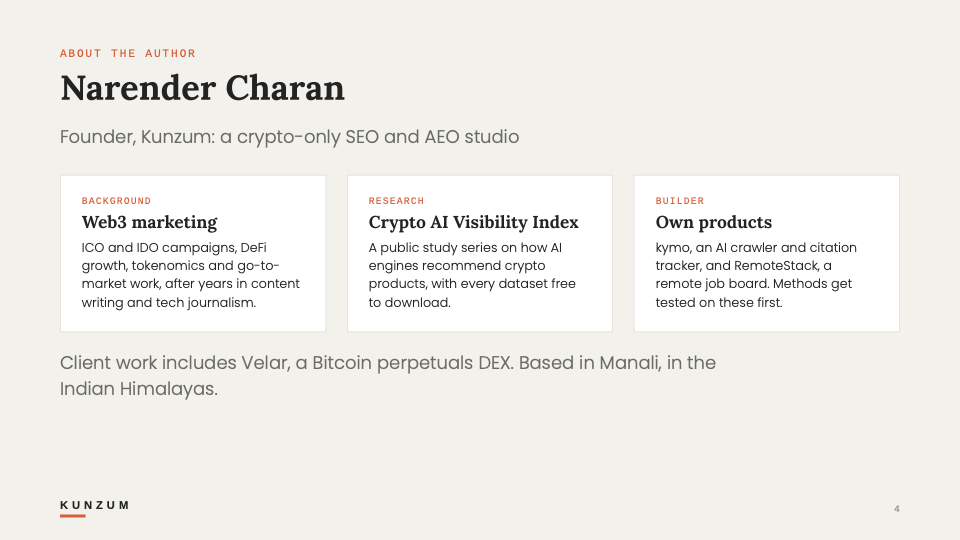
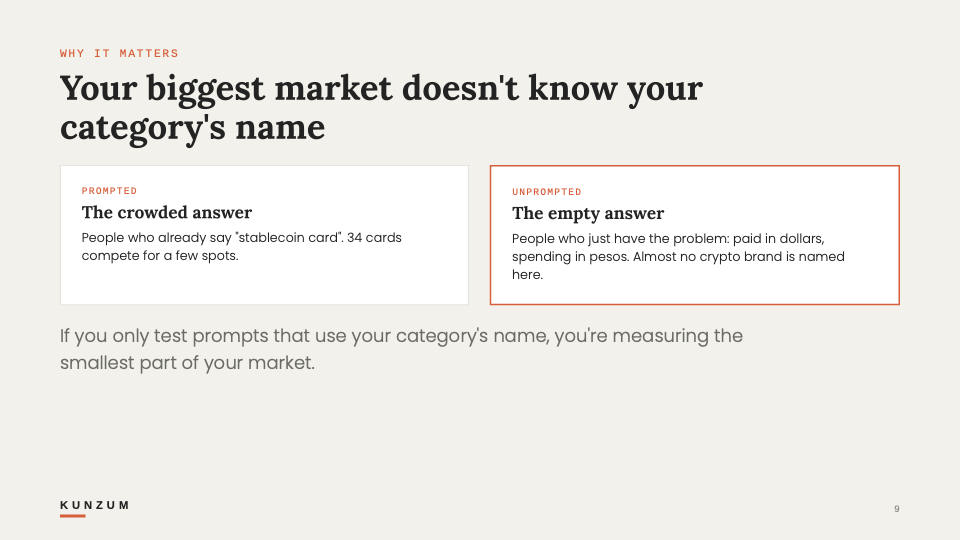
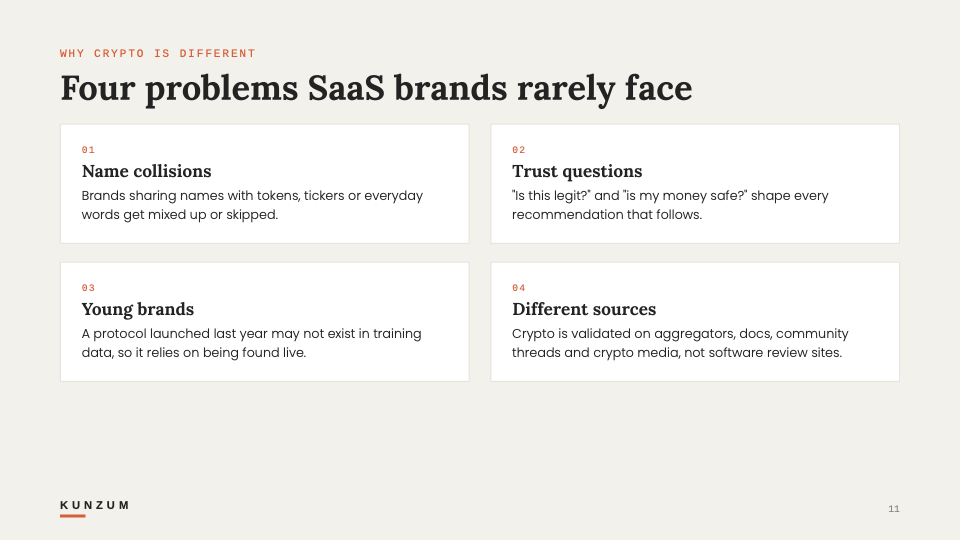
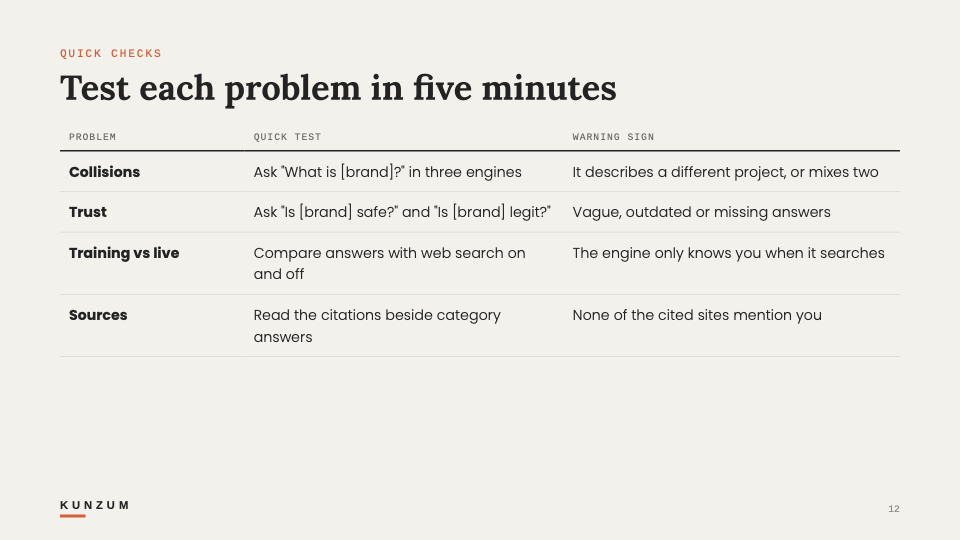
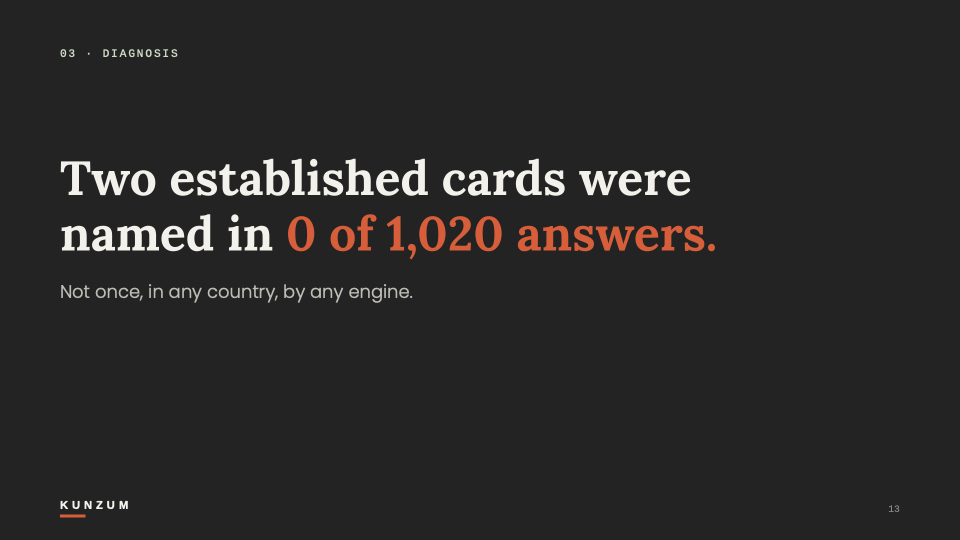
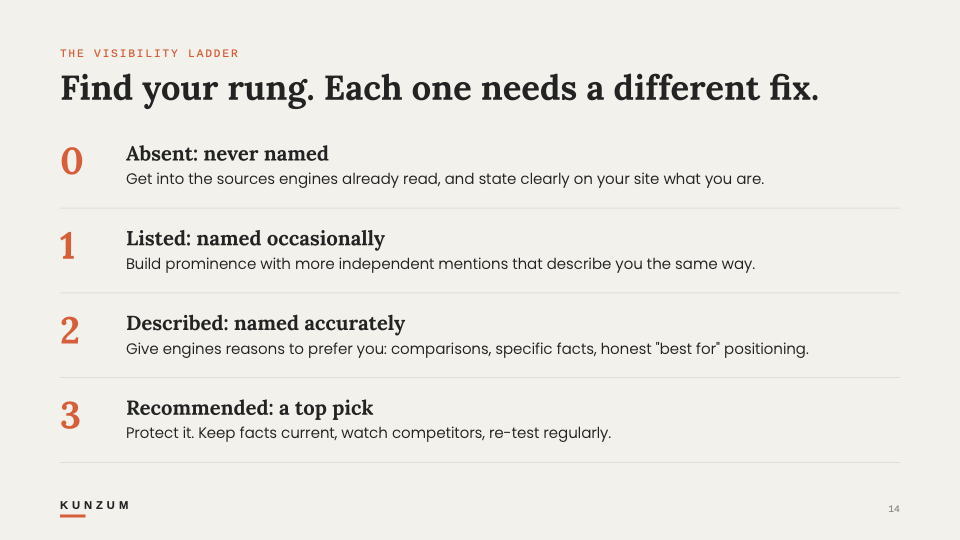
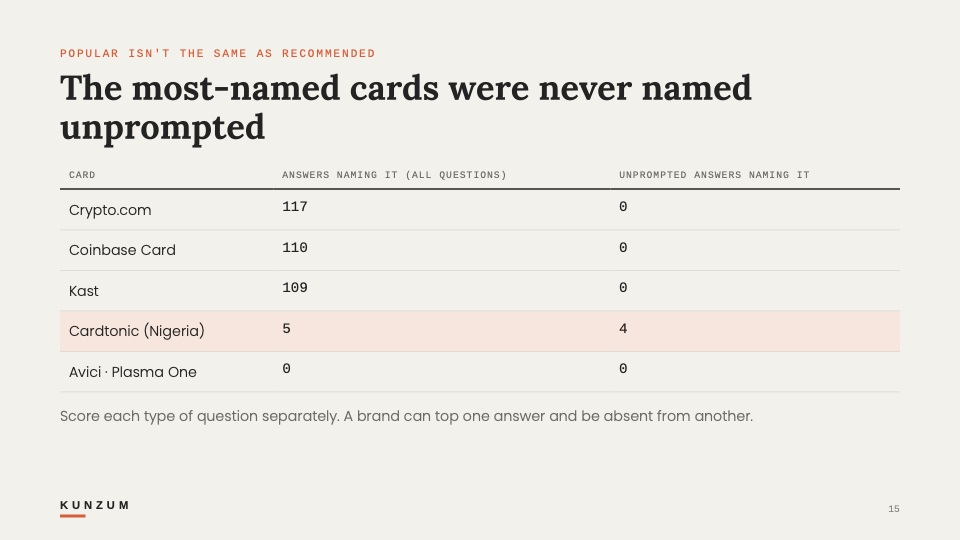
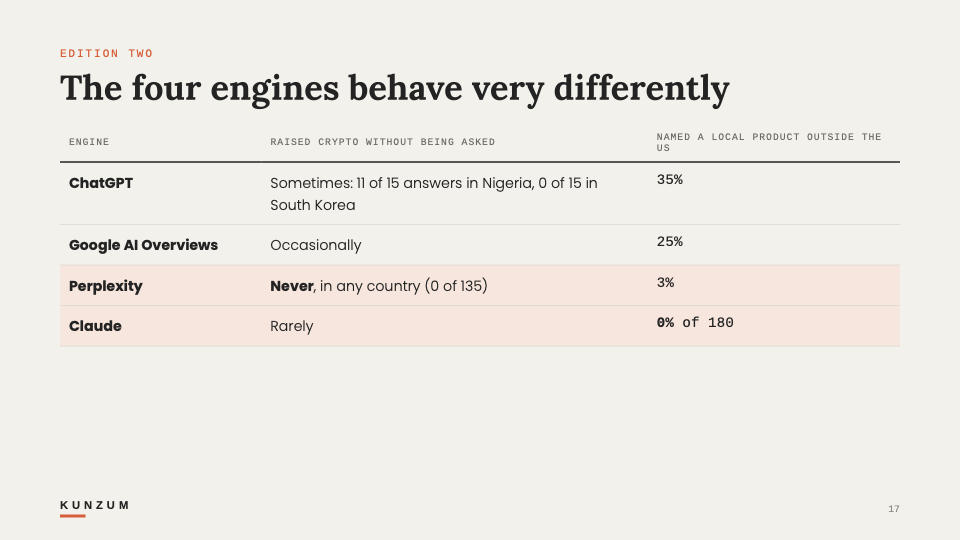
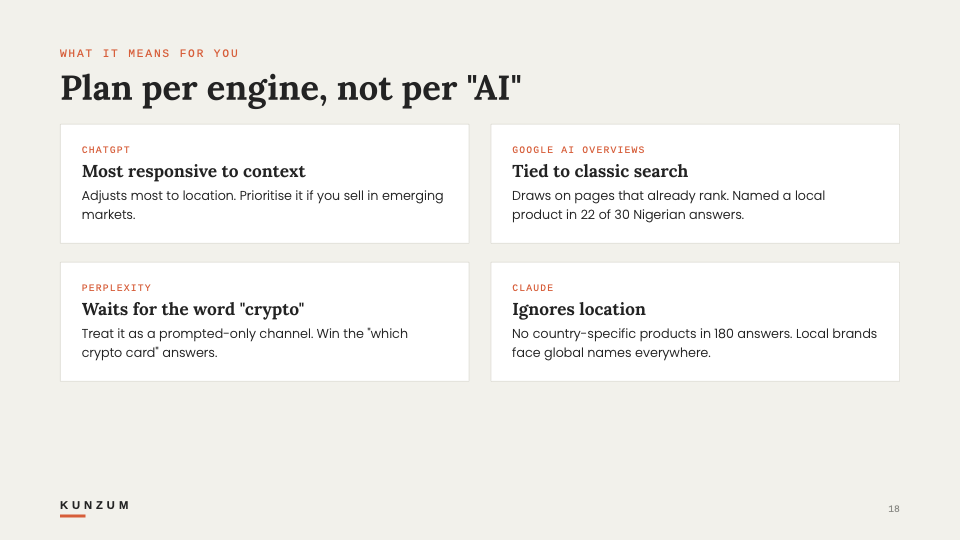
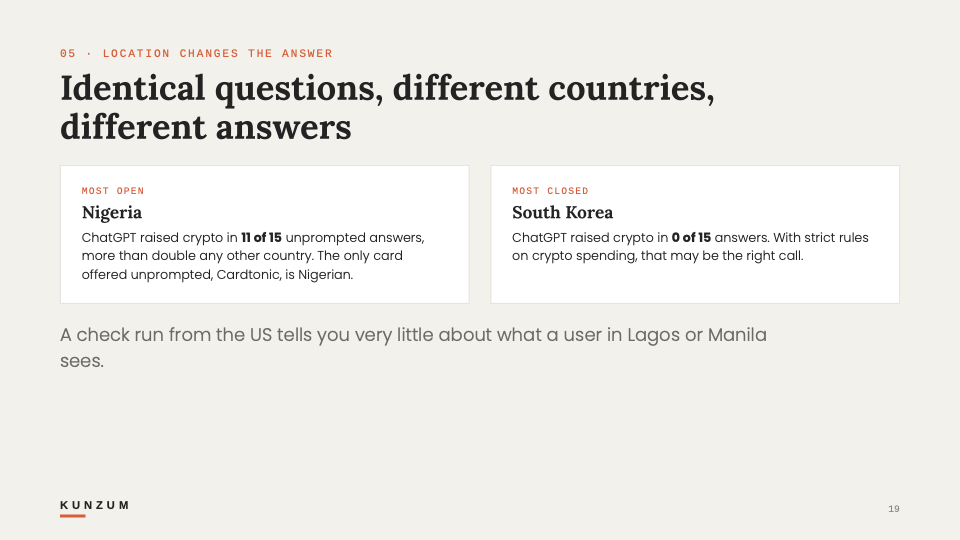
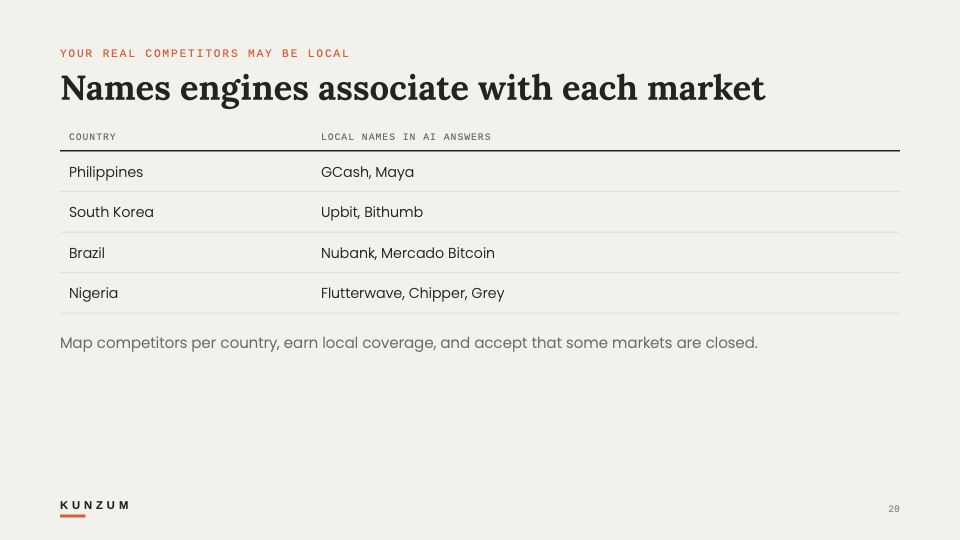
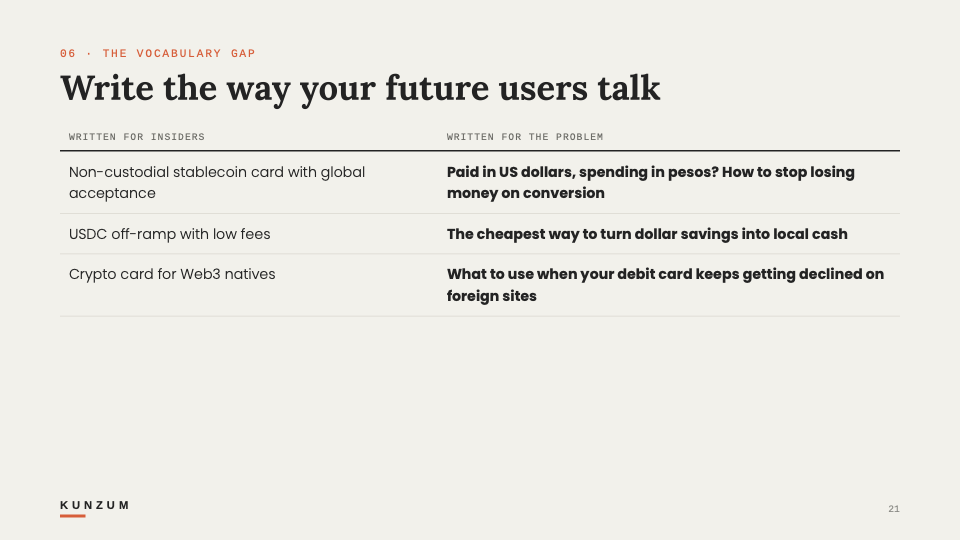
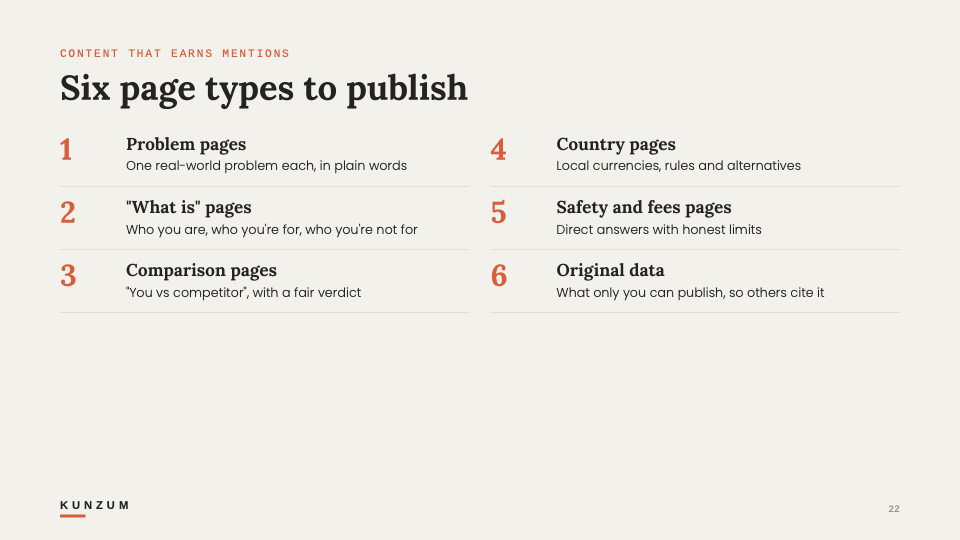
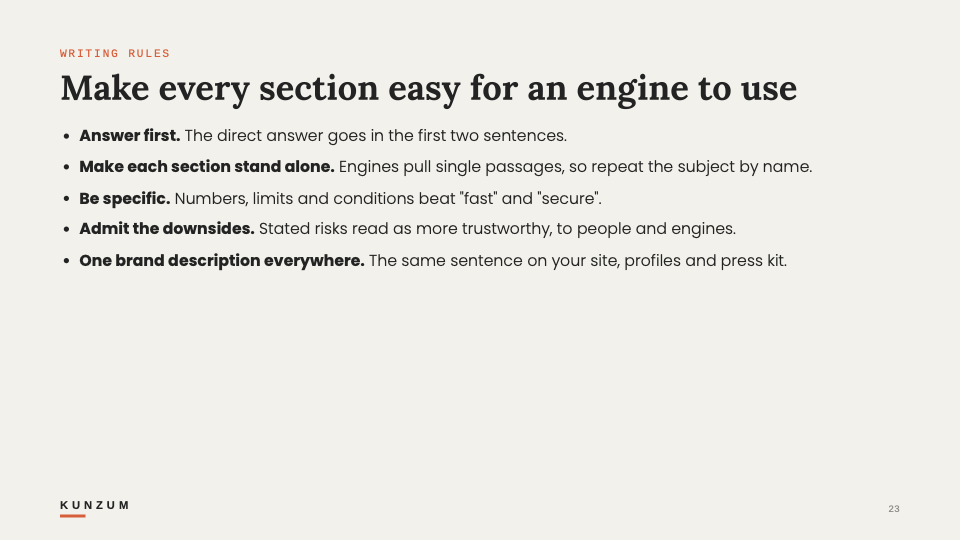
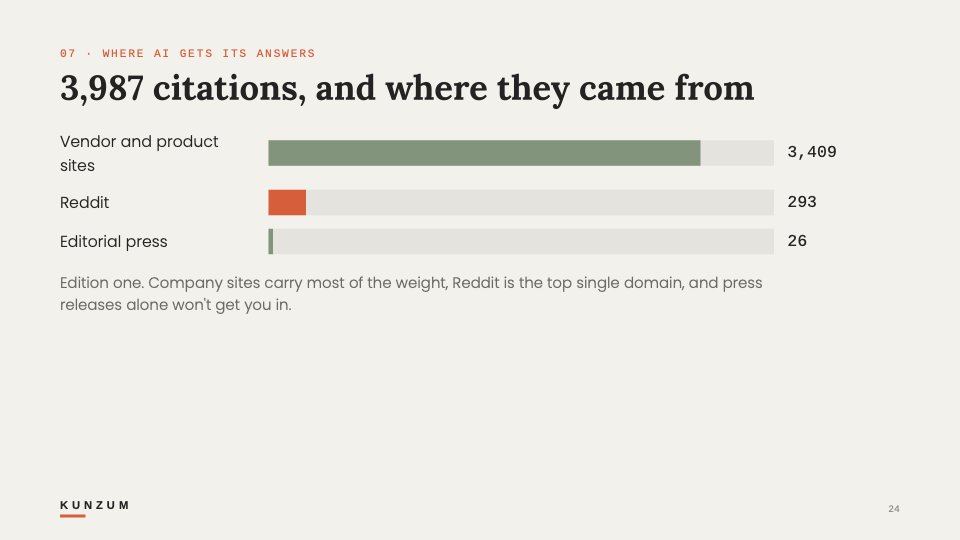
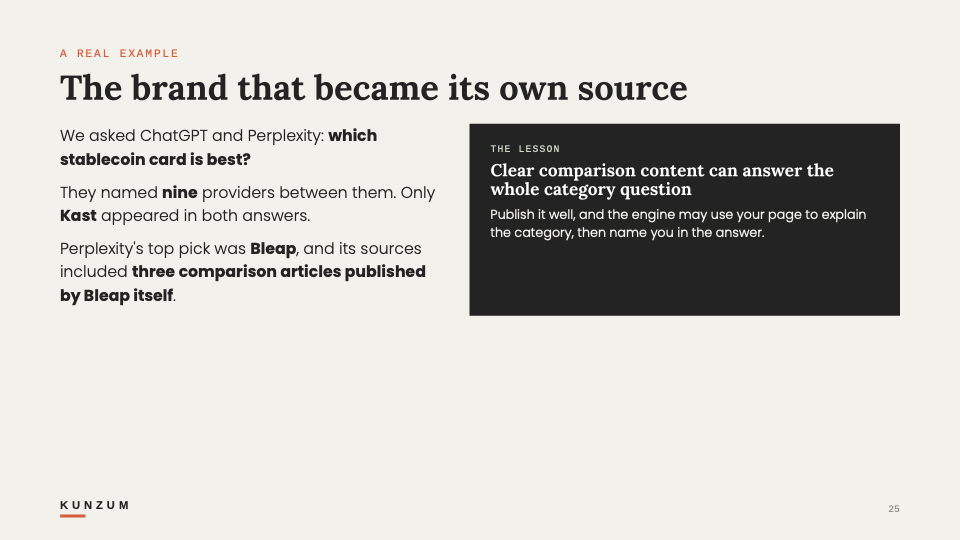
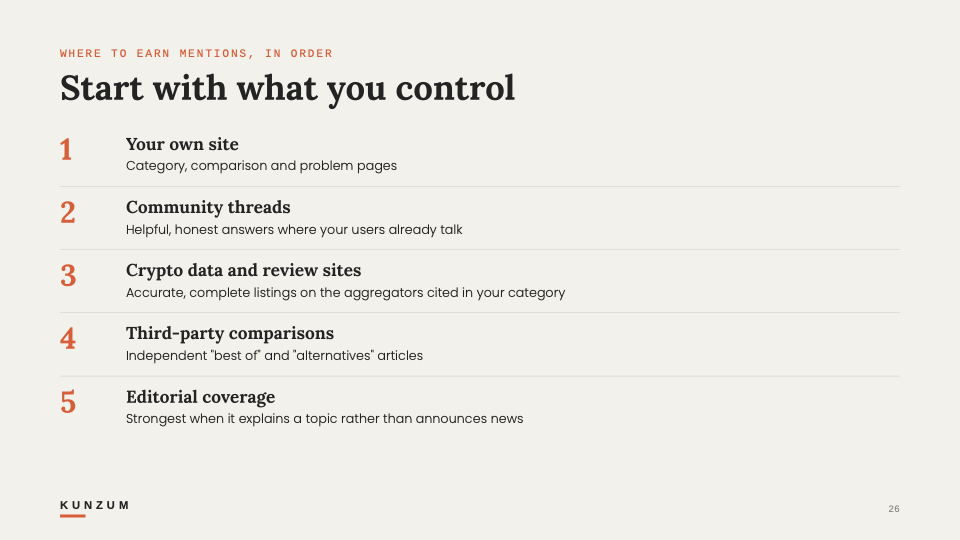
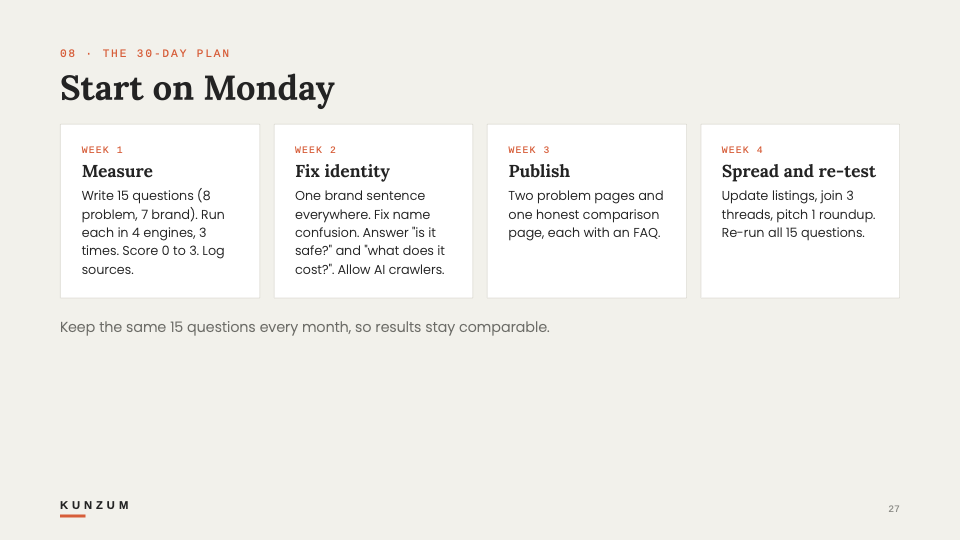
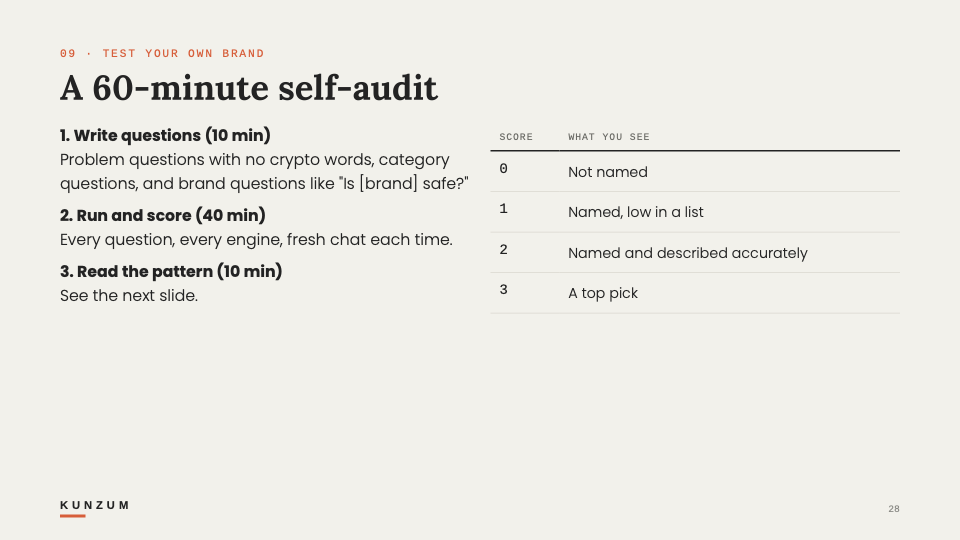
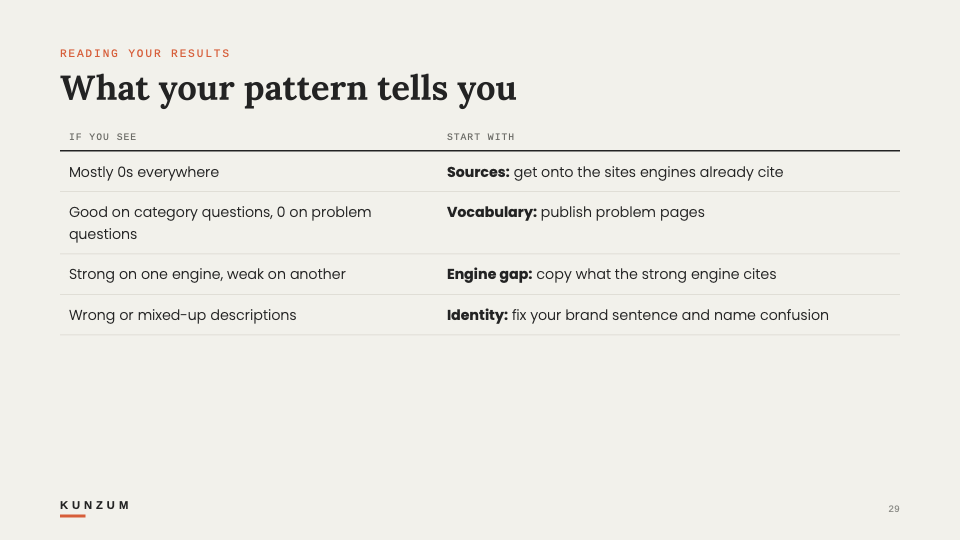
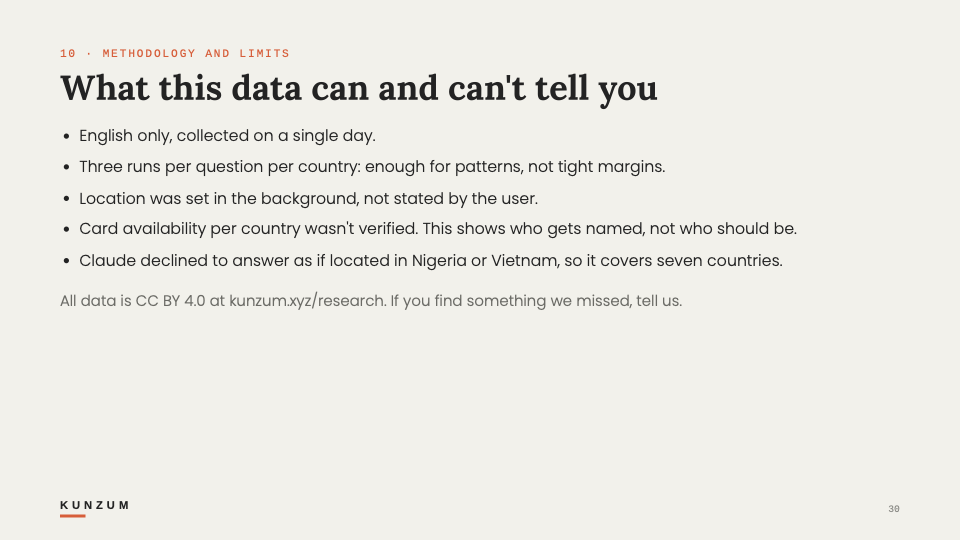
Download the deck (33 slides, PDF) · 16:9, sized for a screen · free to present with credit to Kunzum.
Built on public data
Nothing in the playbook rests on a number you have to take on trust. Every answer, every cited source, every product named and the scoring scripts are published at kunzum.xyz/research under CC BY 4.0, with no gate on any of it and no plan to add one. Any figure in these pages can be traced back to the row it came from. If you rescore it and get something different, that is worth an email.
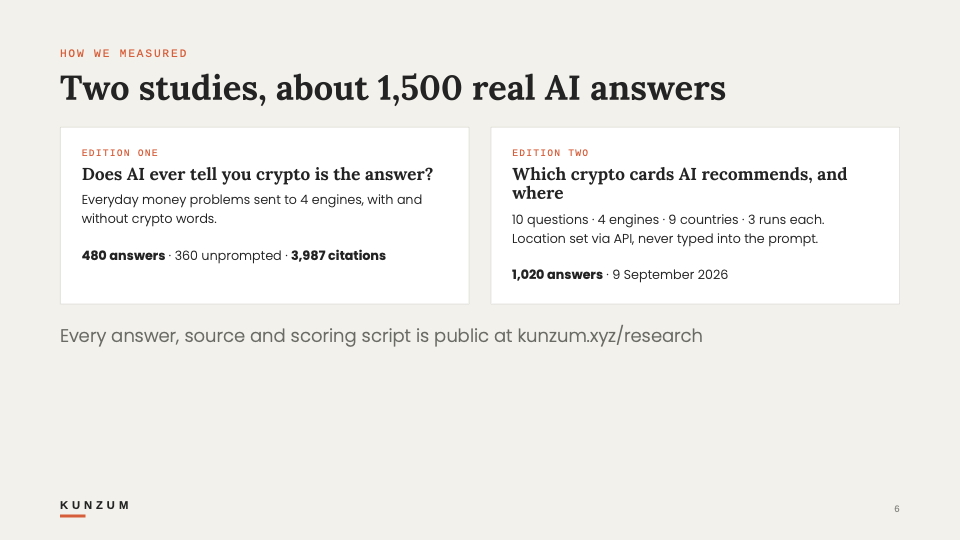
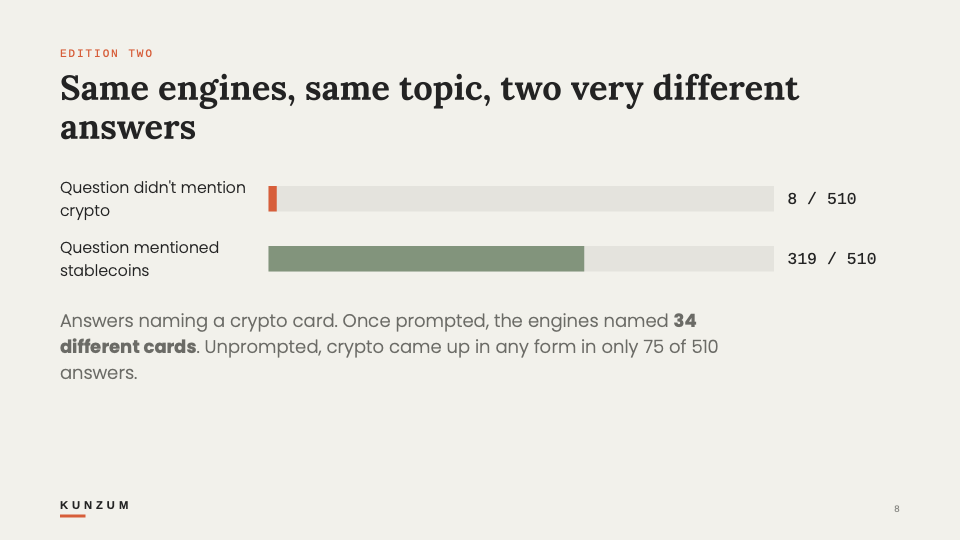
The two editions behind it: Does AI ever tell you crypto is the answer?, 480 answers on whether engines reach for crypto when somebody describes a money problem, and Which crypto cards AI recommends, and where, 1,020 answers across nine countries. Both have their raw corpus attached: edition one and edition two.
Who it is for
Three groups, and the book assumes a different amount of patience from each.
Founders and CMOs
At exchanges, wallets, crypto cards, stablecoin products and DeFi protocols, deciding whether any of this is worth a quarter of attention.
Growth and content leads
Who own organic acquisition and need to know where answer engines sit next to the search traffic they already report on.
Agencies and consultants
Who need crypto-specific evidence rather than generic AEO advice they cannot source when a client pushes back.
Who wrote it

Narender Charan, Founder, Kunzum. Kunzum is a crypto-only SEO and AEO studio, working with exchanges, wallets, crypto cards, stablecoin products and DeFi protocols on getting named and cited by answer engines.
He has worked in Web3 marketing, tech journalism and product building, and runs the Crypto AI Visibility Index, the research series this playbook is built from. More at about.
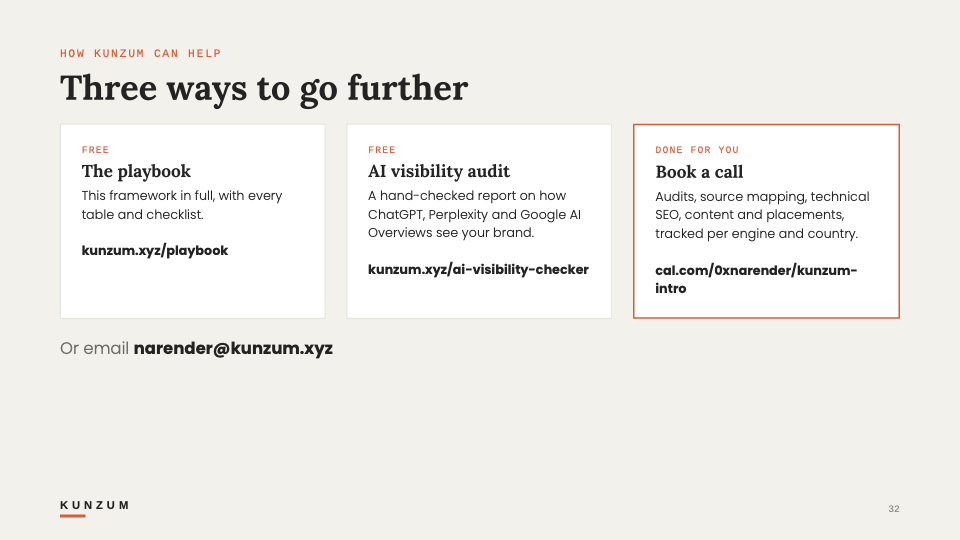
Three ways to go further
The book, the audit, or a conversation. In that order of commitment.
Or email narender@kunzum.xyz.
Questions
Is the playbook free?
Yes. It costs one email address and nothing else. There is no call, no card and no sequence: you get two links, and that is the end of it. If you would rather not hand over an address, the 33-slide deck is on this page with no form at all and carries the same argument.
Why ask for an email if the research is public?
Because the research and the playbook are different things. Every answer, source and scoring script behind it is published at kunzum.xyz/research with no gate, and always will be. The playbook is the part where we tell you what to do about it, and knowing who is reading that is the only thing Kunzum asks for in return.
Has any of this actually worked?
On the cases we can show you, yes. Ask ChatGPT, Claude, Perplexity or Google who built the world's first bitcoin perp DEX and they answer Velar, because the category had no written definition until we wrote one and placed it where engines read. The full transcripts, dated and re-runnable, are on the Velar case study.
Where does the data come from?
Two editions of Kunzum's Crypto AI Visibility Index, about 1,500 answers collected from four AI engines across nine countries. Every answer, every cited source and every scoring script is published, so anything in the playbook can be checked against the corpus it came from.
Can I share it?
Yes, with credit to Kunzum. Send the deck rather than the book if you want to save somebody the form. The underlying data is CC BY 4.0.
Sources
- “Crypto Startup Velar Plans Perpetual Swaps Exchange for Bitcoin DeFi After Raising $3.5M”. CoinDesk. Checked 2026-09-18.
- “Velar PerpDex Launches on Stacks as First Bitcoin-Native Perpetual DEX”. The Defiant. Checked 2026-09-18.
- Panther Academy. Panther Protocol. Checked 2026-09-18.
Published 2026-09-17. Written by Narender Charan, who runs Kunzum.